Chlorine dioxide water purification drops are best known as a compact field tool for hikers, campers, travelers, and emergency preparedness kits. A small two-part kit can help make questionable water safer to drink when clean water is not available. But many people eventually ask a bigger question: Can the same two-part chlorine dioxide drops be used for larger amounts of water, such as several gallons, storage containers, RV tanks, holding tanks, or wells? The answer is yes, in some situations — but with important limits.
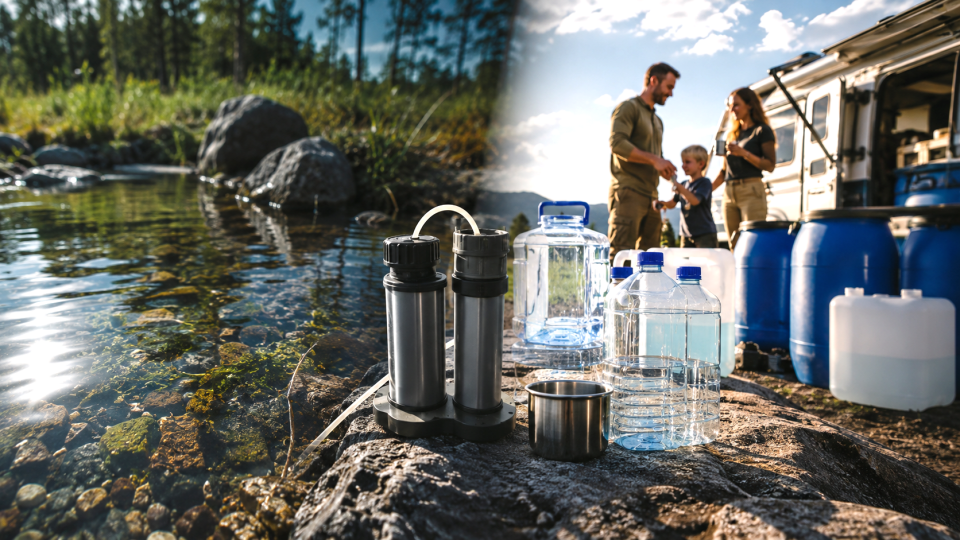
Small-batch use is usually simple. Larger-volume use requires more care, better mixing, longer contact time, and, ideally, testing.
How Two-Part Chlorine Dioxide Drops Work
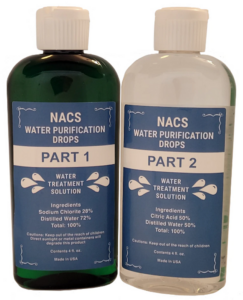
Most two-part chlorine dioxide kits keep the ingredients separate until use.
In general:
- Part 1 contains a sodium chlorite solution
- Part 2 contains an acid activator
- When combined, chlorine dioxide is created on demand
This is one of the major advantages of the two-part system. The active purifier does not exist until the drops are combined. Kept separate in cool, dark conditions, the components can remain useful for long-term storage.
This makes chlorine dioxide attractive for:
- emergency kits
- camping gear
- travel packs
- home preparedness
- stored water backup
- off-grid water systems
Small Containers vs. Larger Water Volumes
For a single bottle or canteen, users simply follow the label instructions for that product. For gallons of water, the same idea applies — but scale matters. Different brands use different concentrations, drop sizes, activation times, and contact times. That means there is no universal “one true” drop count that applies to every product.
Some manufacturers provide instructions for:
- 1 quart or 1 liter
- 1 gallon
- 5 gallons
- 30–60 gallons
- RV tanks
- cisterns or storage containers
The most responsible rule is: Always follow the exact label for the product being used.
Common Manufacturer-Style Examples
Depending on the product, some water purification drops are labeled around small-batch ratios such as:
- drops per liter
- drops per quart
- drops per gallon
- larger batch instructions for multiple gallons
Some manufacturers use simple one-to-one activation systems. Others require longer activation periods, longer contact times, or different amounts depending on water quality.
Cloudy, cold, or highly contaminated water usually requires more caution because organic matter can interfere with disinfection.
In practical terms:
- clear water is easier to treat
- cloudy water should usually be filtered first
- colder water may require longer time
- standing water may require more care than flowing water
Larger Emergency Containers
For 3- to 5-gallon containers, chlorine dioxide drops may be useful when label directions provide scaling guidance.
Common uses include:
- emergency water jugs
- camping containers
- countertop storage
- off-grid household backup
- travel water storage
The key is thorough mixing.
After adding activated chlorine dioxide to a larger container, the water should be stirred, shaken, or circulated enough to distribute the solution evenly.
A common mistake is treating a large volume as if the purifier automatically spreads instantly. It does not. Mixing matters.
Holding Tanks and RV Tanks
Holding tanks, RV tanks, and similar water-storage systems introduce another challenge: surfaces. The water itself is not the only issue.
Tank walls, hoses, valves, and plumbing lines may contain:
- biofilm
- stagnant residue
- mineral buildup
- microbial films
- old water deposits
Chlorine dioxide is often valued in water-system maintenance because it is discussed for biofilm control and odor reduction. For these uses, many people rely on product labels designed specifically for tanks or larger systems, rather than ordinary small-bottle drinking-water instructions. For tanks, the goal is usually not just treating the water, but allowing treated water to contact the entire internal system.
That may involve:
- filling the tank
- circulating treated water
- allowing contact time
- flushing afterward
- testing before drinking
Wells Require More Caution
Wells are different. A private well is not just a container of water. It is a water source connected to underground geology, casing, plumbing, pressure tanks, and household distribution lines.
For this reason, well treatment should not be approached casually with drop-count guesswork.
Well water should ideally be tested for:
- bacteria
- nitrates
- metals
- minerals
- pH
- turbidity
- chemical contamination
A disinfectant can reduce many biological contaminants, but it does not remove chemical pollution, fuel contamination, agricultural runoff, heavy metals, or radioactive materials.
For wells, the best practice is to work with a qualified well professional or local health department and test the water afterward.

Chlorine Dioxide Is Not a Filter
This point is important. Chlorine dioxide helps disinfect water.
It does not physically remove:
- mud
- sediment
- heavy metals
- pesticides
- petroleum products
- dissolved chemicals
- radioactive contamination
For questionable water, a layered approach is often best:
- Let sediment settle
- Pre-filter through cloth or a proper filter
- Treat with chlorine dioxide according to label instructions
- Allow proper contact time
- Store in a clean container
Why Testing Matters
For larger water systems, the safest approach is not merely counting drops. It is confirming results. Water-treatment professionals often think in terms of disinfectant residuals, contact time, and contaminant testing.
For household users, this may include:
- chlorine dioxide test strips
- bacterial water testing
- professional lab testing
- odor and clarity inspection
- proper storage sanitation
If water is being prepared for long-term storage or household use, testing adds confidence.
Why Chlorine Dioxide Remains Popular
Chlorine dioxide has become a favorite among outdoor and preparedness users because it is:
- portable
- lightweight
- shelf-stable when unmixed
- effective in many water-purification settings
- useful for emergency storage
- practical for field conditions
It bridges two worlds:
Small enough for a backpack.
Useful enough for larger emergency water planning.
Closing Thought
Chlorine dioxide drops are simple, but water safety is not always simple.
For a bottle, canteen, or gallon jug, label directions may be enough.
For holding tanks, RV systems, and wells, the better approach is to think like a water-treatment professional:
- treat
- mix
- wait
- test
- confirm
The beauty of chlorine dioxide is that it can be created on demand from a compact two-part kit.
The responsibility is knowing when a simple field method is enough and when larger water systems require measurement, testing, and professional care.
FAQ
How do chlorine dioxide water purification drops work?
They create chlorine dioxide on demand by combining two separate components, which are then added to water according to label directions.
Can chlorine dioxide be used for large water storage containers?
Many products provide instructions for larger volumes, including multiple gallons and emergency storage systems.
Is chlorine dioxide suitable for RV water tanks?
Many RV owners use chlorine dioxide-based sanitation methods for tank maintenance and water-system cleaning.
Can chlorine dioxide purify well water?
Well systems are more complex than small containers and should be tested and evaluated appropriately after treatment.
Does chlorine dioxide remove heavy metals?
No. Chlorine dioxide disinfects water but does not physically remove heavy metals, pesticides, petroleum products, or other chemical contaminants.
Disclaimer
This article is for educational purposes only. Always follow the manufacturer’s label directions for any water purification product. Chlorine dioxide products vary by concentration, activation time, and intended use. Chemical disinfection does not remove sediment, heavy metals, pesticides, petroleum products, radioactive material, or all chemical contaminants. For wells, tanks, or household systems, consult qualified water-treatment professionals and confirm safety through appropriate testing.
Leave a Reply